Buyer guide · Private label wellness product sourcing
How to source private label women's wellness products from China.
An essential sourcing guide for established brands, retailers and distributors expanding their wellness product collections.
SENVORAE · Published October 26, 2026 · 8 min read
The short answer
Start with the brief,
not the catalogue.
Finding a product that looks promising is only the beginning. A useful sourcing project connects the product idea to a real customer, sales channel, target market, quantity range and launch decision.
Before comparing factory prices, make the project specific enough to answer three questions: what are you trying to add, who is it for, and what would make it commercially workable?
That does not mean every technical detail must be final. It means fixed decisions, flexible variables and open questions should be visible from the start.
01 · Define the commercial project
Before contacting suppliers, define why the product belongs in your collection. Who is the intended customer? What need or routine will the product support? How does it complement what you already sell? What makes your version different from available alternatives?
A retailer expanding into intimate wellness may need a coordinated care collection rather than several unrelated SKUs. An established brand may prefer one focused category with differentiated packaging and a clear positioning.
A useful starting brief
- □ Brand, current channel and target customer
- □ Product category and intended use
- □ Destination market and sales route
- □ Estimated quantity, budget and timing
- □ What is fixed, preferred or optional
02 · Clarify the development route
Private label, OEM and ODM are not interchangeable promises.
Private label generally involves selling an existing or adaptable product under your own brand, where legally and commercially appropriate. ODM generally involves adapting a supplier-developed design or product. OEM generally refers to manufacturing according to specifications provided or commissioned by the customer.
In practice, suppliers use these terms differently. Ask what is actually included: product changes, materials, formulation, tooling, packaging, testing, artwork and approval rounds. The more differentiated the product, the more important this scope clarification becomes.
Separate requirements into essential, preferred and optional. This keeps a supplier conversation useful when feasibility, cost or documentation changes the first idea.
03 · Ask for the right MOQ
MOQ is not necessarily a fixed number for an entire product category. It can change with the exact specification, raw materials, packaging components, production setup and degree of customization.
Instead of asking only, “What is your MOQ?”, ask: “What is the minimum quantity for this exact product specification and customization level?” Clarify whether it applies per product, color, packaging version or total order.
Compare MOQ, unit price, setup cost, packaging and inventory exposure together. The right quantity is the one that fits a realistic launch plan and working-capital position—not simply the lowest number a supplier mentions.
04 · Evaluate evidence, not only price
A quotation is a starting point.
It is not supplier qualification.
Relevant manufacturing experience and scope
Product- and site-specific documents
Quality-control and change-management process
Subcontracting, inspection and communication responsibilities
Request documents that relate to the product and manufacturing site under consideration. A certificate or test report is not universal proof that every product made by a supplier meets every destination-market requirement.
05 · Treat compliance as product-specific
Intended use and claims can change the regulatory question.
Women's wellness includes products that may fall under different regulatory frameworks. A cleansing wipe, a formulated product and a wellness accessory should not automatically be treated as the same type of product.
For example, the U.S. FDA says wipes intended for cleansing or moisturizing the skin, including feminine or other personal cleansing, are regulated as cosmetics; wipes marketed for therapeutic purposes may be drugs. FDA also states that cosmetic facility registration and product listing under MoCRA are not an approval program and do not come with an FDA certificate proving compliance.
Before approving production, define the destination market, intended use, product classification, applicable requirements, documentation responsibilities and proposed claims. Health-related advertising claims should be truthful, not misleading and adequately substantiated.
Official references: FDA Disposable Wipes · FDA MoCRA Registration & Listing · FTC Health Products Compliance Guidance
This article provides procurement guidance, not legal, medical or regulatory advice. Confirm the actual product and claims with qualified specialists before market entry.
06 · Make sampling an approval gate
Specification
Dimensions, materials, formula or construction requirements.
Use
Function, feel, fit, durability or compatibility questions.
Presentation
Branding, pack format, labeling inputs and protection in transit.
Evidence
Testing, inspection or documentation needed for the project.
Changes
What happens if a component or process changes after approval.
Record
The approved sample, version and open issues kept together.
07 · Compare total project cost and timing
Unit price alone does not tell you what a product will cost to launch. Depending on the project, additional costs may include sample development, tooling, packaging design, testing, inspection, freight, duties and other import-related charges.
Ask what is included and what is separate. Agree on the Incoterms rule and named place instead of relying on an undefined shipping price. Compare consistent assumptions, including the cost of bringing an approved product to the intended market.
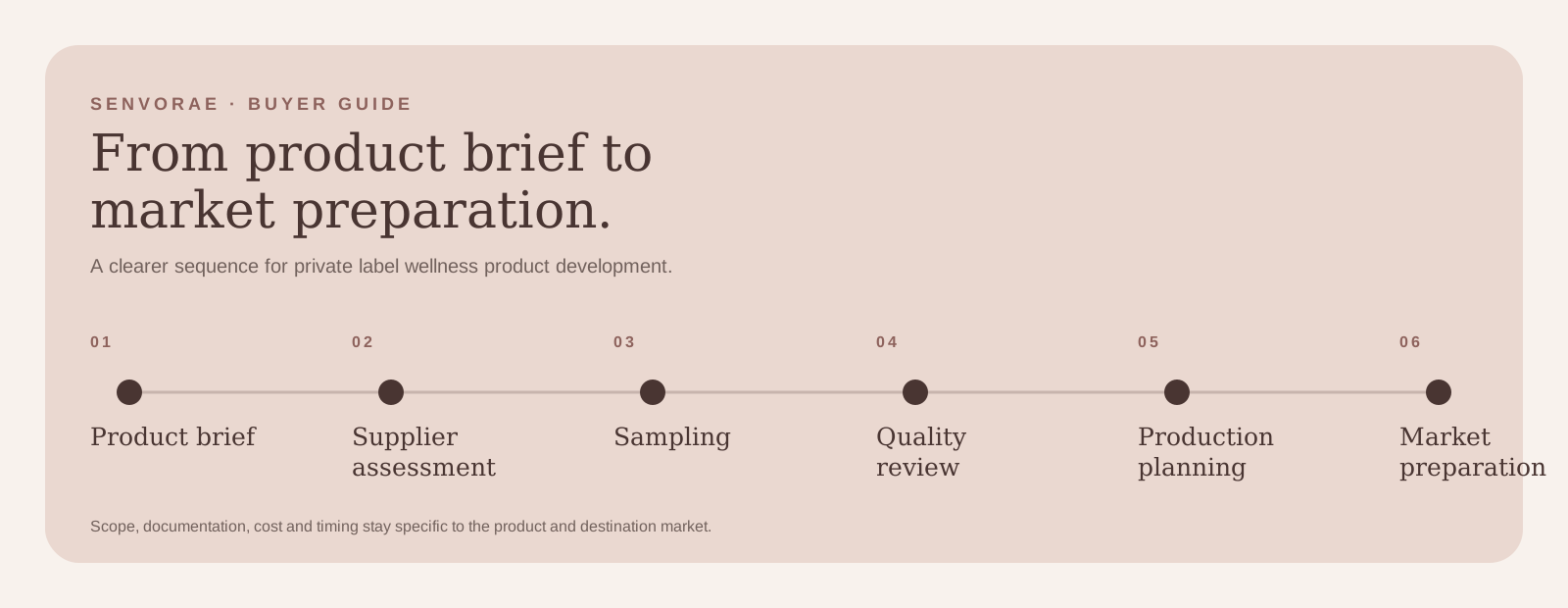
Development is also a sequence: specification review, supplier assessment, quotation, sampling, revisions, testing, packaging approval, production, inspection and shipment.
Build in decision points and contingency time. An estimated production lead time is not a guaranteed market launch date.
- 01
Product brief
Customer, channel, product objective, market and commercial range.
- 02
Supplier assessment
Relevant manufacturing fit, documentation and project questions.
- 03
Sampling
A physical or documented check against the agreed specification.
- 04
Quality review
Materials, construction, claims and approval criteria reviewed.
- 05
Production planning
Packaging, inspection, responsibilities and timing clarified.
- 06
Market preparation
Labeling, logistics and launch assumptions checked for the target market.
08 · Prepare the buyer brief
The more specific the brief,
the more useful the next decision.
Brand & market
Business type, sales channels and destination market.
Product category
Product or collection and intended use.
Specifications
Dimensions, materials, colors and essential details.
Customization
Branding, packaging or new development requirements.
Quantity & budget
Estimated initial order and realistic commercial range.
Timeline & compliance
Launch milestones and known documentation expectations.
You do not need every technical detail finalized before starting a sourcing discussion. A complete brief simply makes missing information, feasibility questions and the next useful step easier to see.
Working with a China-based product development and sourcing partner
Coordination matters when the product is still being defined.
Depending on the agreed project scope, a partner may help structure the conversation between brand requirements and supplier capabilities, coordinate supplier research, support sample discussions and keep project questions visible. This does not replace independent product testing, regulatory review or the responsibilities of the manufacturer and importer.
SENVORAE focuses on women's wellness product development and sourcing coordination for brands exploring thoughtfully developed product collections. The starting point is the brand's commercial requirement and product brief.
FAQ
Useful before
you request a quote.
What is the difference between private label, OEM and ODM?
Private label usually means selling an existing or adaptable product under your brand. ODM commonly involves adapting a supplier-developed design, while OEM usually means manufacturing to customer-defined specifications. The exact scope depends on the supplier and project agreement.
Can I order private label wellness products in small quantities?
Possibly, but there is no universal MOQ. The minimum depends on the product, materials, packaging, production setup and customization level. Ask for the MOQ for your exact specification, not for a broad category.
Do all women's wellness products require the same certifications?
No. Requirements depend on intended use, product classification, destination market and applicable law. Documentation must be assessed for the specific product and claims.
Should I request samples before bulk production?
Yes. A documented sample and approval process helps confirm that the proposed product meets the agreed requirements before a production commitment.
What should I include when requesting a quotation?
Include your product category, target market, intended use, specifications, customization requirements, estimated quantity, budget range and target timing. Add reference images or drawings when they clarify the brief.